
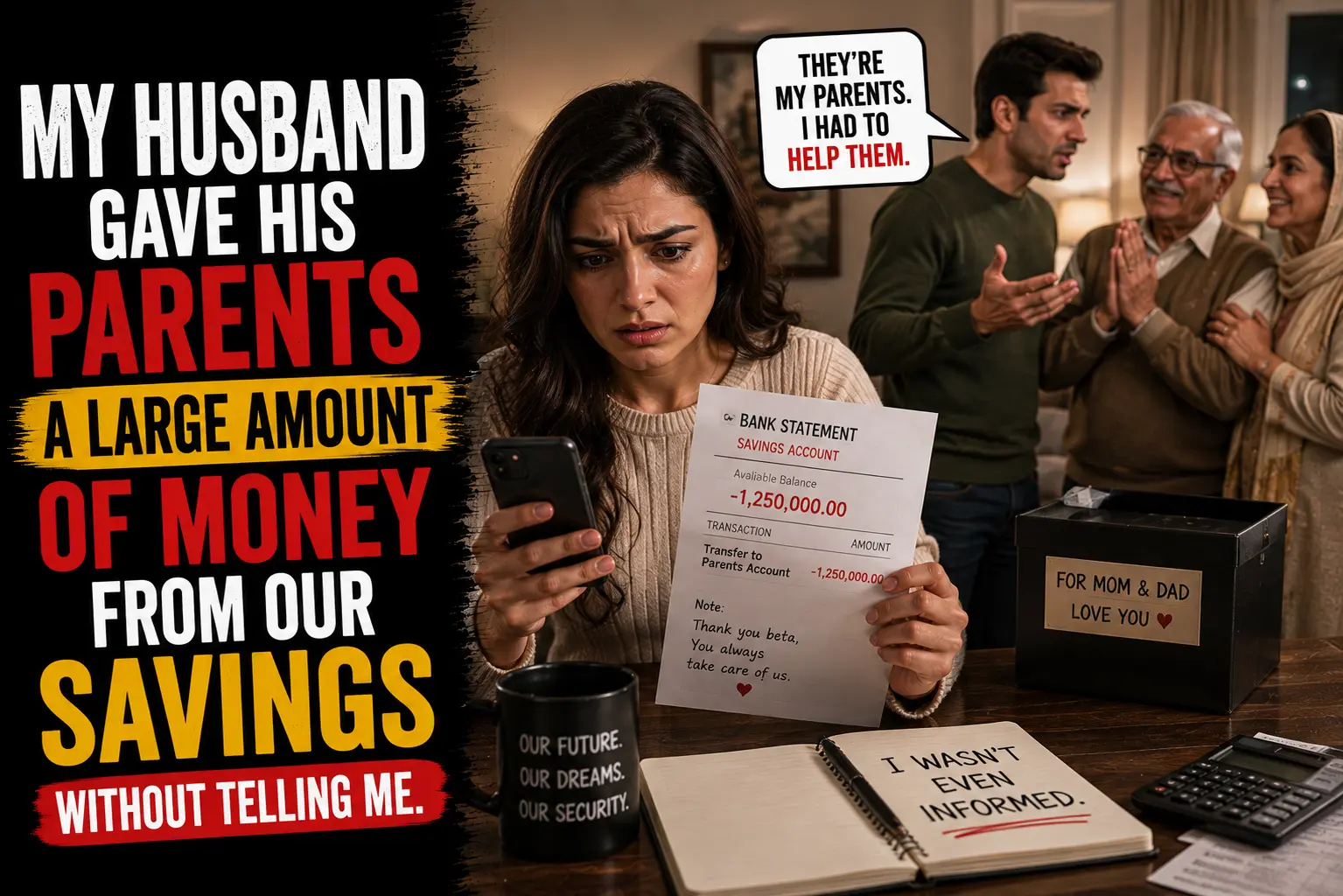
I found out my husband gave his parents a huge amount of money from our joint savings without even mentioning it to me. He says they’re his family and needed help. I keep thinking the money isn’t the biggest issue anymore—it’s the fact that he decided our savings were his to give away.
I thought we were saving for our future.
Apparently, he thought our savings became his whenever his family needed them.
Now I don’t know what I’m supposed to trust anymore.
I’m 30F, and my husband is 33M. We’ve been married for five years, and we’ve always considered ourselves careful with money.
We both work full-time.
We both contribute to a joint savings account.
That account isn’t for vacations or impulse purchases.
It’s our emergency fund.
Our future house renovations.
The money we hoped would eventually help us raise children.
From the beginning, we had one simple rule.
Major financial decisions required two yeses.
His parents have struggled financially on and off for years.
I don’t hate them.
In fact, we’ve helped them before.
We’ve paid for home repairs.
Covered a medical bill.
Loaned them money a couple of years ago.
Every single time, we talked about it first.
Sometimes I even suggested helping before he did.
That’s why this situation feels completely different.
Last week I logged into our savings account because I wanted to move some money into another account.
The balance looked wrong.
For a few seconds, I genuinely thought the bank had made a mistake.
Then I saw the transfer.
A huge one.
To his parents.
When I asked my husband about it, he admitted he had transferred the money almost three weeks earlier.
Three weeks.
He hadn’t forgotten to mention it.
He had simply never mentioned it.
He explained that his parents had fallen behind on their mortgage payments and he panicked because they were terrified of losing their home.
So I asked the obvious question.
“Why didn’t you tell me?”
He said he knew I’d probably want to discuss it first and there “wasn’t time.”
That answer immediately bothered me.
Because the transfer wasn’t made at three in the morning during some crisis.
It happened on a weekday afternoon.
There had been plenty of time for a five-minute conversation.
Would you consider that an emergency that justified acting alone, or would you expect your spouse to call before touching your shared savings?
Then more details came out.
His parents weren’t actually facing immediate foreclosure.
They’d fallen behind on payments and wanted to catch up before additional penalties accumulated.
It was serious.
But it wasn’t happening that afternoon.
There had been time.
He just decided not to involve me.
Then I remembered something that made everything worse.
About a month earlier, I’d suggested replacing my aging car because it was becoming unreliable and expensive to repair.
He told me we couldn’t afford to touch the emergency fund.
I agreed.
I kept driving the old car.
Apparently, we couldn’t spend our shared savings on something we’d discussed together.
But he could transfer a much larger amount without even mentioning it.
From that moment on, every conversation we’d ever had about “our financial goals” started sounding different in my head.
Would you still believe those savings belonged equally to both of you after something like that?
When I finally asked whether his parents planned to repay the money, he looked genuinely confused.
Then he said, “Repay us? They’re my parents.”
I reminded him it hadn’t come from his personal account.
It came from savings we’d built together over five years.
He said I was acting like I cared more about money than family.
That sentence hurt.
Not because I don’t care about family.
Because it completely ignored what I was actually saying.
I spent days wondering if I was becoming cold and selfish.
Then I realized I wasn’t even angry about the money anymore.
I was angry about what I’d become.
I was sitting in my own home wondering whether the account I’d spent years contributing to was actually shared—or simply accessible until my opinion became inconvenient.
I wasn’t upset because he helped his parents.
If he had asked me first, I honestly think there’s a good chance I would’ve agreed.
Maybe not to the full amount.
Maybe we’d have discussed a loan instead of a gift.
But we would’ve decided together.
Instead, he made the decision alone and expected me to accept it afterward.
That completely changed how safe I felt about our finances.
Before I confronted him again, I had one question in my head.
Do I try to move on, or do I protect myself in case this happens again?
I chose protection.
The next day, I opened a separate savings account in my own name.
I told him I’d still contribute to our joint account for household expenses and the financial goals we both agreed on.
But until trust was rebuilt, I wasn’t comfortable putting large amounts into an account that either of us could empty without mutual approval.
He was furious.
He accused me of punishing him for helping his parents.
He said married couples shouldn’t separate money because of one disagreement.
I said, “This isn’t one disagreement. This is one decision that changed how I see every future financial decision.”
Then I suggested something I thought was reasonable.
Any withdrawal above an agreed amount would require both of us to approve it first.
He rejected it immediately.
He said I was treating him like a child.
I answered, “No. I’m treating our marriage like a partnership.”
Maybe that sounded harsher than I intended.
But I meant every word.
Would you have opened your own account too, or did I let one mistake damage our marriage even more?
Now everyone seems divided.
His parents were shocked when they found out I hadn’t known.
They said they assumed he’d discussed everything with me beforehand.
His sister thinks I’m making him choose between his wife and his parents.
My brother says the money itself almost doesn’t matter anymore because trust is harder to replace than savings.
One mutual friend agrees we absolutely should’ve helped his parents but says secretly taking the money crossed a line that has nothing to do with generosity.
Another friend thinks opening my own account sends the message that I’m preparing for divorce instead of repairing our marriage.
And honestly, that criticism stings because I don’t want separate finances forever.
I want to trust my husband again.
My husband has apologized for not telling me.
But then he said something that worries me even more than the transfer itself.
He admitted that if the exact same situation happened again, he’d probably still help his parents first and explain it afterward.
That sentence made everything crystal clear.
His apology was for upsetting me.
Not for believing he had the right to make that decision.
Maybe opening my own savings account immediately was emotional instead of productive.
Maybe I should’ve insisted on counseling or financial planning before changing how we manage money.
I also understand what it must feel like to watch your parents struggle and believe you have the power to save them.
I don’t think helping family is wrong.
I think deciding alone was.
Now I have to decide whether stronger financial safeguards are enough—or whether this revealed something much bigger about how my husband sees our partnership.
What would you do in my position—rebuild trust with new financial rules, or see this as a warning about how every future decision involving his family will work?
Because I can replace money over time.
I’m not sure I can replace the feeling that my vote inside my own marriage became optional the moment it conflicted with someone else’s needs.
Am I overreacting to one desperate decision—or ignoring a warning about the future of our marriage?