
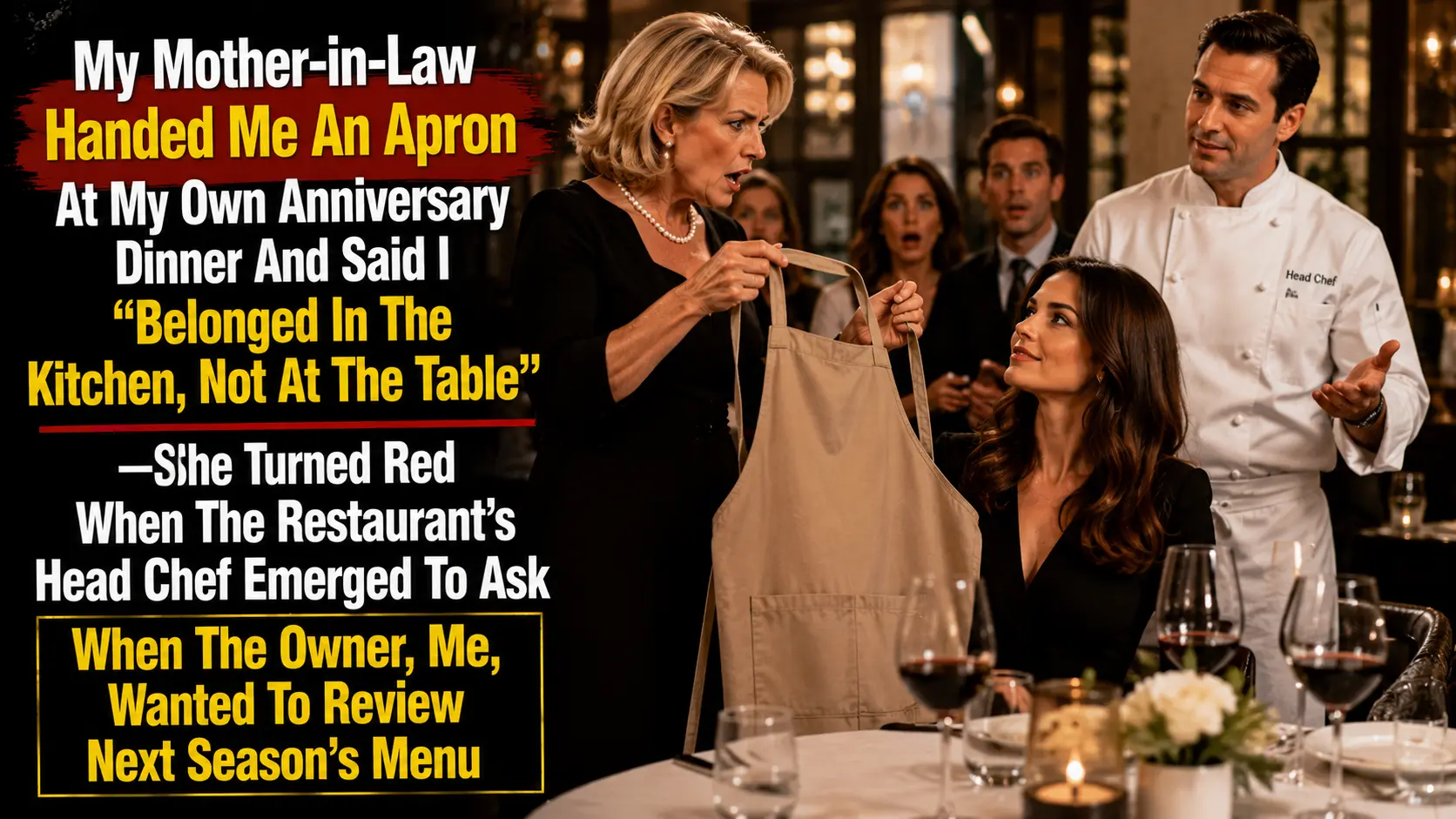
My mother-in-law handed me an apron at my own anniversary dinner. Then she loudly announced I belonged in the kitchen, not at the table. She smiled while everyone stared—until the head chef walked over and changed the entire room.
My spouse and I chose my restaurant for our anniversary because it had always been our favorite place. Ironically, very few people outside my management team knew I actually owned it. I preferred keeping a low profile and letting the staff shine instead of drawing attention to myself. My mother-in-law had never respected my career anyway. She liked to say I only “played restaurant” instead of having a real business. Every family gathering included another joke about when I’d finally get a proper office job. I usually smiled, changed the subject, and let it go. Looking back, I realize that was my biggest mistake. I hated family drama so much that I convinced myself ignoring her would eventually make the comments stop. Instead, my silence only encouraged her to keep going.
As the years passed, the insults became more personal. She constantly compared my work to traditional office jobs and implied I wasn’t contributing as much as my spouse. If another relative congratulated me on the restaurant’s success, she’d immediately dismiss it or steer the conversation somewhere else. My spouse defended me occasionally but usually whispered, “Just let it go. It’s easier this way.” Friends kept telling me I needed to stand up for myself. Instead of addressing the real problem, I responded with sarcasm whenever she criticized my career. I’d make little jokes back, and while they felt satisfying in the moment, they only added more tension without solving anything.
On our anniversary, she arrived looking unusually confident. Halfway through dinner, she reached into a gift bag, pulled out a plain apron, slid it across the table, and loudly declared, “You belong in the kitchen serving people, not sitting at this table.” Conversations throughout the restaurant stopped. I could feel every pair of eyes in the dining room turn toward me. For a moment, I wanted to fire back. I was embarrassed, angry, and honestly humiliated. Then something inside me shifted. I realized I’d spent years protecting someone who had never cared about protecting my dignity. I also admitted an uncomfortable truth: by pretending her comments didn’t bother me, I’d convinced everyone else they were harmless too. That wasn’t who I wanted to be anymore. Instead of arguing, I stayed exactly where I was. For the first time, I refused to rescue her from the consequences of her own assumptions.
Just as the silence became unbearable, our head chef walked over carrying a folder. Smiling politely, he said, “Excuse me, I didn’t want to interrupt your celebration, but when would you like to review next season’s menu? We need the owner’s final approval before printing everything.” I thanked him, opened my calendar, and scheduled the meeting for Monday morning. I never announced that I owned the restaurant. I never looked at my mother-in-law. I simply continued the conversation as though nothing unusual had happened. When the chef walked away, my mother-in-law’s face had turned bright red. Without saying a word, she quietly pushed the apron back into her gift bag. In that moment, I realized something important. The truth doesn’t need an audience—it just needs the right moment.
The family split almost immediately. Some relatives apologized for underestimating my work and admitted they’d believed my mother-in-law’s version of my career for years. Others accused me of setting her up for public humiliation by never correcting her sooner. My friends called it karma finally catching up with her. My spouse admitted they should have defended me long before that night but wished the truth hadn’t come out in front of everyone. My mother-in-law insisted I’d intentionally hidden the fact that I owned the restaurant just to make her look foolish. The conversation stopped being about her insult and became a debate over whether I’d handled the situation fairly.
I still love running my restaurant, and every anniversary reminds me why I built it in the first place. But my relationship with my mother-in-law has never fully recovered, and sometimes I wonder whether staying silent all those years protected my peace—or simply delayed the inevitable.
Tell me honestly—did I cross a line, or did they deserve it?